He Should Bring Us – קוממיות – To Our Land
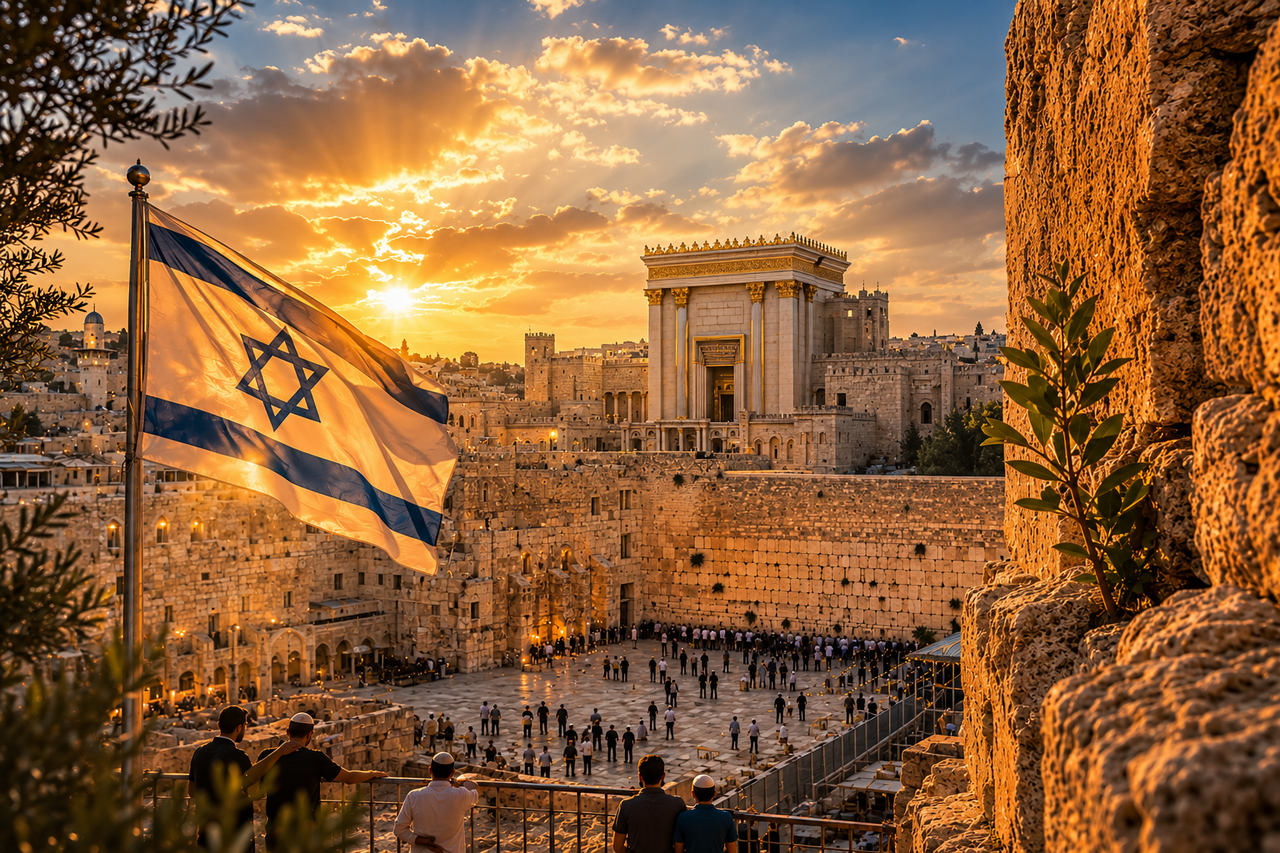
It was just about noon on June 7th, 1967, that Yossi Ronen, out of breath and with sweaty palms, picked up the phone and called in to Galei Tzahal — Israel’s national radio. As the only correspondent present with the Israeli troops at the moment that Yerushalayim was unified, they immediately put him on the air:
“I can barely speak — we just came back from the Kotel HaMa’aravi. I was in the first group of paratroopers that arrived there. At the head were Aluf Uri Narkis, Aluf Bar-Lev, and the Chief Rabbi of Tzahal, Aluf HaRav Goren, who was carrying with him a Sefer Torah and a Shofar.
We were all crouched down as bullets were flying. But HaRav Goren was walking upright in the middle with the Torah and Shofar, as if the bullets flying around could not touch him. He was simply, quite simply, not shayach to this world at all. It’s as if he was in a different sphere entirely. You needed to see it. The soldiers began marching through, not feeling at all like they were in the middle of a war.
We continued through the alleyways of the Old City, over Har HaBayit, to the Kotel HaMa’aravi. Rav Goren blew the Shofar, surrounded by the paratroopers who were all crying — brave soldiers who had just lost their friends and fellow soldiers in the conquest of the Old City. I cannot describe it. They were leaning against the wall and crying.
After blowing the Shofar and reciting the El Maleh Rachamim, Rav Goren led the soldiers in Tefilat Mincha, the first one there in 19 years. Every one of the soldiers participated, and at the conclusion of the Tefillah, they spontaneously erupted into the singing of Hatikvah as the flag was raised above the Kotel.”
In expressing His brachos to the Jewish People, Hashem concludes: “I am the Lord your God, who brought you forth out of the land of Egypt, that you should not be their bondmen; and I have broken the bars of your yoke, and made you go upright” — וָאֶשְׁבֹּר מֹטֹת עֻלְּכֶם וָאוֹלֵךְ אֶתְכֶם קוֹמְמִיּוּת.
The image of Rav Goren walking through the ancient alleyways of the Old City, bullets flying as soldier after soldier begins raising his head, oblivious to the war around them — this is the bracha of קֽוֹמְמִיּֽוּת, walking upright. But it is not just a posture; it’s a perspective.
In every person, in every relationship, there are various levels, various spheres of existence. A married couple, for example, can exist on a level of pure pragmatism — he does carpool, she makes dinner. But there is a level beyond that, one to which we all strive: that our relationships are not just a sharing of chores, but a unity of hopes, dreams, and lives.
Chazal (Bava Basra 75a) explain that the word קוממיות doesn’t mean merely upright, but doubly so:
ואולך אתכם קוממיות רבי מאיר אומר מאתים אמה כשתי קומות של אדם הראשון
The verse states: “And I will make you go upright [komemiyyut]” (Leviticus 26:13). Rabbi Meir says: In the future, the Jewish people will have the stature of two hundred cubits, equivalent to two times the height [komot] of Adam, the first man, whose height was one hundred cubits. Rabbi Meir interprets the word komemiyyut as two komot.
Obviously, this does not mean that Adam was two hundred feet tall, but that he was created with a sense of wholeness, of completion, both physically and spiritually. That’s the bracha of קוממיות — being doubly complete.
To continue our mashal: this is when making dinner expresses a unity of purpose beyond simply satisfying hunger, and when doing carpool is an expression of the great will to raise, build, and nurture a family.
The Gra explains this unity as expressed by the Navi Hoshea (2:18): תִּקְרְאִי אִישִׁי וְלֹא־תִקְרְאִי־לִי עוֹד בַּעְלִי — “And it shall be on that day,” says Hashem, “that you will call Me ‘Ishi,’ and no longer call Me ‘Baali.’”
There are two ways to refer to a husband in Hebrew: Ba’ali — my master, or Ishi — my person, my man. Ba’al is impersonal and distant. But one day the entire world will call Hashem “Ishi,” appreciating the internal sharing of dreams and lives.
This was the קוממיות of Rav Goren in that moment, the קוממיות of the soldiers as they achieved the dream of a nation for 2,000 years: Har HaBayit b’yadeinu. HaKotel b’yadeinu. It’s a completion that transcends the mundanities of our world.
Of course, this unity is not available anywhere and everywhere. The Gemara in Brachos (8a) explains:
דאמר ר' חייא בר אמי משמיה דעולא מיום שחרב בית המקדש אין לו להקב”ה בעולמו אלא ארבע אמות של הלכה בלבד.
Rabbi Ḥiyya bar Ami said in the name of Ulla: Since the day the Temple, where the Divine Presence rested in this world, was destroyed, the Holy One, Blessed be He, has only one place in His world where He reveals His Presence exclusively: the four cubits where the study of halakha is undertaken.
Since the destruction of Yerushalayim, we only had available to us the koma of Torah — spiritual elevation and perfection. But it could never fully manifest in the physical world. We had to choose: either to engage in gashmiyus or in ruchniyus.
Since the destruction of the Beis HaMikdash, we retained the emotional connection of yearning and longing for Yerushalayim, with no way or place to anchor it. We wandered; we were chased, lost, and unwanted by the nations of the earth. “Dirty Jew,” “stingy Jew,” they called us — and now they call us that again.
And while the world of Torah flourished, while sefarim were written and yeshivos were built, we languished in poverty, misery, and disgrace. This is the galus, the exile of the Shechina. The value of Torah, morality, and love was lost to the world. To be called a Jew was an insult.
But this changed in 1967.
People who were there remember the euphoria, the קוממיות of that era. Jews were proud to be Jews.
Yerushalayim — the ladder of heaven in Yaakov’s dream — connects to earth. As the Shem Mishmuel writes: שהיא צירוף וחבור עולם בעולם — it’s the place of connecting this world with the world above.
Yerushalayim is the yichud room. It’s the place where every aspect of our relationship with Hashem can be fully and completely expressed. And the whole world saw that simcha, that joy of a nation that had come home — the chosson and kallah finally being together.
One day later, the first Jew to enter the Ma’arat HaMachpeilah — the burial place of the Patriarchs and Matriarchs — in some 800 or 900 years was General Moshe Dayan. When he entered, he did not know exactly what to do. But instinctively, he straightened up, offered a sharp salute, and said, “Shalom Aleichem” to Avraham, Yitzchak, and Yaakov.
As the Navi Micha says: כי מציון תצא תורה ודבר ה' מירושלים — Torah goes forth, extends outward, to the whole world from Tzion.
For the Jewish nation to hold onto Yerushalayim means that we are holding onto the place where heaven and earth meet, where gashmiyus and ruchniyus are no longer contradictory, where we can live a life of הרחמן הוא יוליכנו קוממיות לארצנו.
Baruch Hashem, Yerushalayim today is once again the epicenter of the Jewish world. Hundreds of thousands of our brothers and sisters have returned to Yiddishkeit by touching the stones of the Kotel since 1967. For the first time in 2,000 years, the greatest yeshivos in the world are in Yerushalayim.
My rebbe, Rav Blachman, told us that before ’67, the Mirrer Yeshiva — which today has more than 5,000 talmidim — had only one student who learned night seder. Rav Chaim Shmuelevitz’s wife would bring him a glass of milk at night to thank him for learning in the Beis Medrash.
The whole world has changed, and we can once again hold our heads up high, both physically and spiritually.
But we are not physically in Yerushalayim. We’re in Boca. And sometimes we feel like the Golei Bavel — the Babylonian exiles who cried: איך נשיר את שיר ה׳ על אדמת נכר — “How can I sing the song of Hashem on foreign soil?”
Then I remember: our prayer in benching is הרחמן הוא יוליכנו קוממיות לארצנו — “May the Merciful One bring us upright to our land.”
I remember that Rav Goren walked upright through the bullets on the way to Har HaBayit. Perhaps that קוממיות — that pride, wholeness, and completion — is not just available to those already in Eretz Yisrael, but also to those who are on the way there.
This is the question of our generation in Chutz La’Aretz: Which way are we going?
Are we moving toward a life of קוממיות, a life of Yerushalayim? Or are we, God forbid, cashing out and enjoying material success until the return of the new, modern day cossacks and crusaders?
This week we will celebrate 59 years of having Yerushalayim.
Let’s commit ourselves to becoming Yerushalayim — if not yet in physical placement, then at least in our minds and hearts.
Let us aspire to a world of קוממיות, where Hashem and His Torah are manifest in every dinner we cook, every carpool we drive, every Tefillah we offer, every Daf we learn, and every deal we make.
For though we may be far from home, our home is being rebuilt. May we merit to help complete it, במהרה בימינו.