The Other Jews, on the Other Front Lines
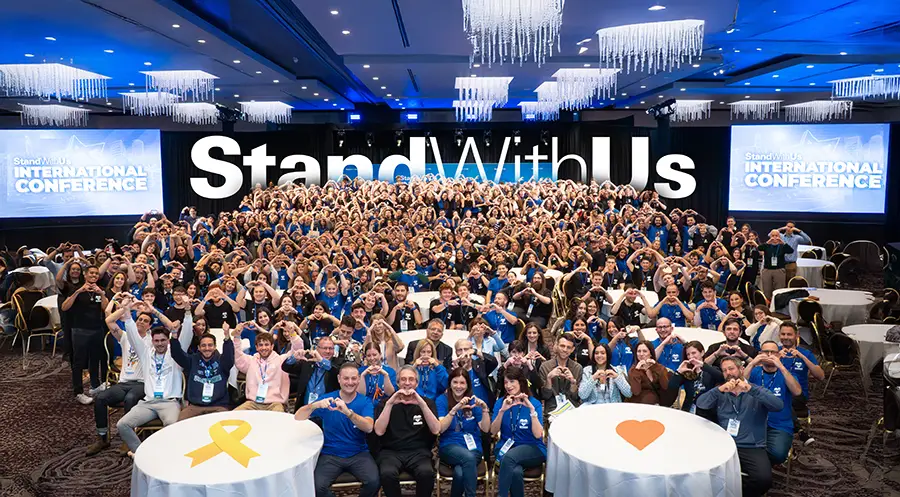
This week, I met a group of Jews fighting on a front line that I know little about.
I was invited to attend the annual StandWithUs conference in Las Vegas. (It was my first time ever visiting Las Vegas, and truthfully, I struggled to see the appeal of the city… but that’s a story for another time.)
It was inspiring to see hundreds of cohorts of college students and high school students—many of whom did not grow up observant—all in support of Israel. The feeling was warm, celebratory, and electric.
But the sessions that the rabbis were invited to attend unveiled the nastier side of what’s at stake: conversations about safety, security, and how to secure governmental funding; presentations about harassment and antisemitism in the workplace; and the legalities of where to draw the line between free speech, hate speech, and incitement.
Perhaps the most eye-opening conversation was the unscripted lunchtime exchange with rabbis, cantors, and community leaders across denominations.
For the first 20 minutes, I sat like a fly on the wall, listening to them speak. They spoke about rampant antisemitism plaguing their communities, the work they were doing on interfaith committees—trying to get leaders of other religious groups to support them. They exchanged war stories of town mayors who openly support Hamas, and how every discussion quickly turns to, “What about Islamophobia?”
One of them mentioned how two Jewish teens had been beaten up in a local mall, and how the police commissioner was forced to temper his response. After all, he had already been accused of being a Zionist and couldn’t afford the political fallout of appearing so publicly Jewish again.
For kids in their communities, Jew-hatred was a part of daily life.
For years, they have been feeling the fatigue of fighting an ever-growing sense of isolation. No one wants to write letters anymore. Social media campaigns fall flat, and protests are barely attended.
In that moment, I realized how privileged and insulated we are here in Boca Raton.
They looked at me and asked if I had any best practices to share. I confessed that I didn’t. This isn’t the work that rabbis in Boca are typically involved in.
I described the wonderful life that our kids have here—how our own BRS West community has grown from twenty families to two hundred in the past decade. Our schools are bursting at the seams, and almost every week, we’re hosting another young family that wants to move to Florida.
One of the other leaders at the table glared at me.
“I am so happy for you and your community. But I can’t help feeling a deep sense of resentment and rejection. You have a beautiful Jewish life and a growing community. Many families from our towns have moved to Florida. We’re happy for them, but every one that moves weakens us. They’re looking for the safety and security that Boca offers. They’re moving for the warmth and sunshine, and the chance to escape to a place where ‘Zionist’ is not a slur. But you have no idea what we’re living through.”
She was right. I had no idea.
For my own kids, the antisemitic attacks they know most about are rockets from Iran. They hear how their cousins are running to shelters and enduring Zoom school. They hear about the chayalim, the hostages, and their families. But they don’t know about the American kids their age who are bullied and shunned on school buses every day.
It dawned on me that there really are two front lines—and we are not fighting on either of them.
The Mozitzer Rebbe writes on the word ויקרא—with a small alef: everything in the world is “mikreh”—happenstance—until you realize that there’s a little Alef hiding behind it. And when you see that Alef, you remember that there is only One God. The moment you remember that, nothing is happenstance any longer. The word ויקר (happenstance) becomes ויקרא—a calling.
I paused.
I don’t know how many Orthodox rabbis this woman had met, and I don’t know what feelings she has toward Orthodox Jews. But Hashem put me in that place, at that time, with those people—a confluence of events I couldn’t possibly have arranged myself.
So I made her the only offer I could—an offer that I desperately hope you will help me fulfill.
I told her that she should never be afraid or ashamed to call on her Orthodox brothers and sisters. We will be there.
I hope that you will agree with me.
If it ever happens that an outlying Jewish community—of any denomination—needs help, we want to be there for them.
If there is a group of Jews arranging a protest outside a mall where Israelis have been barred from entry, we need to be there.
If there is a letter-writing campaign to the governor, we need to be writing.
If we can lend our voices—our likes, clicks, and shares—to any Jew in distress, it is our moral and halachic obligation to do so.
It’s time to find the little Alef. Hashem is inviting us to answer the call—to announce to the rest of Klal Yisrael that He is calling us all back to a world of Torah, mitzvos, and love for each other.