The Problems with a Perfect World
When everything is taken care of — what will you do with your life?
I was pretty sure it was fake news or some sensationalist clickbait.
The headline read: “The gym might soon be a pill.”
Subtitle: New drug tricks your muscles into thinking they're moving, burning fat and strengthening fibers without leaving the couch ... Same result, no treadmill.
Spoiler alert: it’s some drug they tried on mice that might have added to their muscle mass. (Personal trainers, your jobs are safe... for now.)
But then again, the world is changing faster than ever before. We now have weight loss drugs so powerful that, for the first time in history, Americans are less obese this year than last.
It might not be so far-fetched to think that someone could develop a drug to strengthen our muscles, heal our bones, and help us live healthier and longer lives with minimal effort.
This is far from the only area where human effort is becoming less necessary.
This week, I wanted to update the layout of my blog – raelblumenthal.org – please check it out and let me know what you think!)
It took ChatGPT less than a minute to rewrite all the code I needed. Yes, I needed to tweak it a little, but all things considered, it was amazingly efficient. So efficient that my friends in the high-tech world have told me that coding is essentially a dead career.
This is happening in every sphere, from medicine to marketing. AI is replacing humans in some way in every industry.
Naturally, the doomsday prophets have all but conceded that we are heading toward a massive economic collapse in which vast percentages of humanity will be rendered futile.
I am neither an economist nor a prophet. I don’t know if the world is on the brink of a catastrophic crisis. But I do know that Hashem is posing an ancient question to us on the largest scale we’ve ever seen.
The question is simple:
If everything were perfect, what would you do with your life?
Think about it.
If you could get fit and healthy by taking a shot or a pill.
If you could make a fantastic living by barely lifting a finger.
If your physical needs were all taken care of, what would you do with your life?
For most of human history, this question was laughable. Imagine describing this to your great-grandmothers in Europe, Morocco, or Persia. Imagine telling them that we’re teetering on the brink of a world where living in luxury—or at least extreme convenience—might be attainable for almost anyone, irrespective of their education or skill set.
But nothing is new under the sun. And we, the Jewish people in particular, have been through this experience once before in our history.
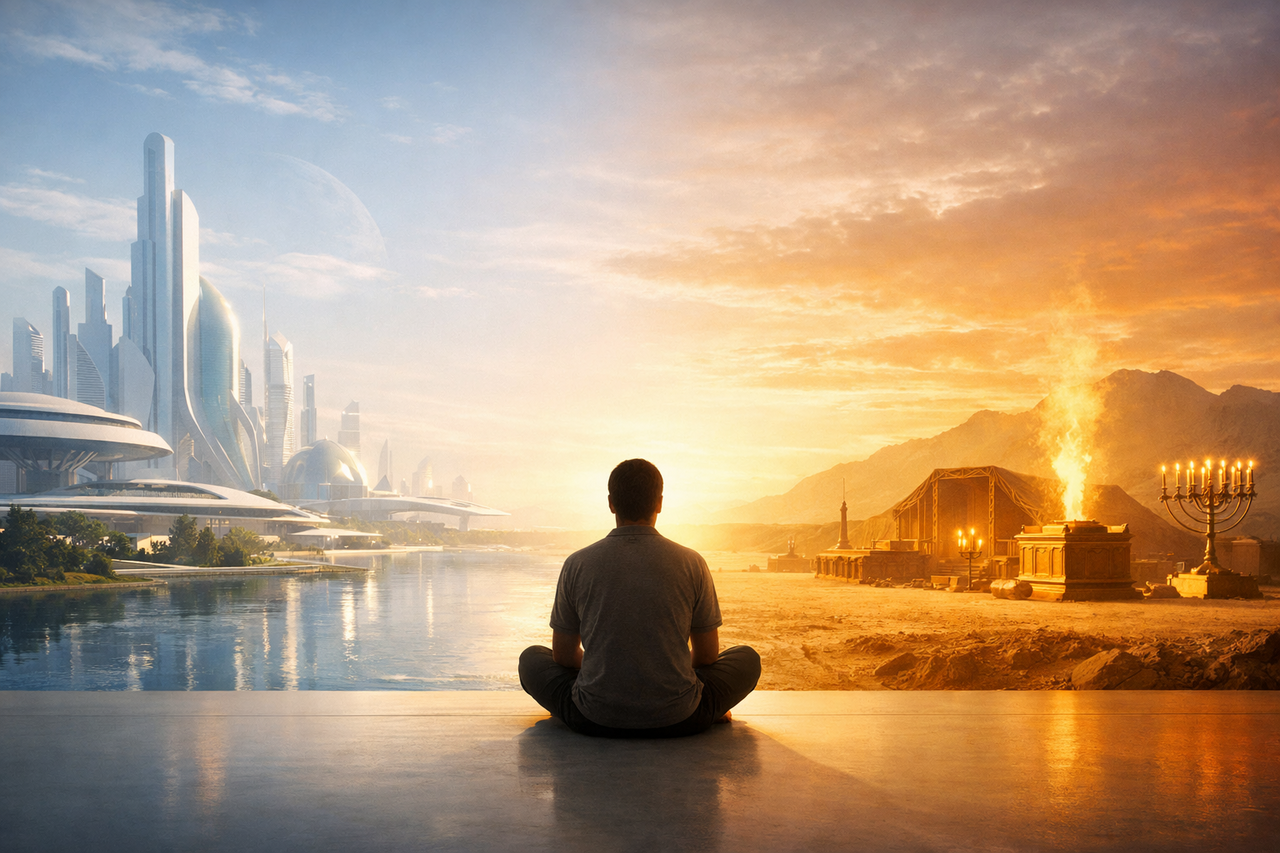
This was the strange utopia of the Midbar—a world where food fell from Heaven. Water flowed from a rock. Clothes were laundered by the Ananei HaKavod, and obstacles on the road ahead were smoothed out by the pillars of cloud and fire.
Imagine the whiplash of entering this world.
After centuries of slavery, our ancestors suddenly found themselves totally free. Not simply liberated from Pharaoh, but from labor. In a matter of weeks, money became meaningless. The gold, silver, and riches of Egypt were relegated to outdated trinkets. Who needs them when we lack nothing?
What could one possibly do with wealth and status in the miraculous society of the Midbar?
But there is a far more unsettling question:
What does a utopian society do all day?
Without the existential struggle for survival and stability, what is life about? How do you fill your day?
The simple answer, of course, is to prepare for the next stage. Utopia will not last forever. At some point, we will enter the Land of Israel. We will once again plow the fields, sow our grain, and pray for rain. We will train our soldiers, defend our borders, and work on transforming humanity. We will illuminate the world with the guiding lights of ethical monotheism.
When we get there, all of our wealth, strength, and status will exist in service of these great goals.
The training ground for these national and societal aspirations in the Midbar took the form of building the Mishkan.
Everything we have, everything we earn, can be dedicated, directed, and donated to creating a place for Hashem in this world.
It is not surprising that the construction of the Mishkan takes up so much of Sefer Shemos. In the lives of our illustrious forebearers, the act of constructing the Mishkan was far more than simply creating a place for Hashem.
It filled a hole in their lives that desperately needed filling. It provided an outlet for personal mastery, for social collaboration, and for purpose in their daily lives.
Slowly, the Torah reveals that on the deepest level, the structure of the Mishkan was nothing short of a realignment of Creation. The Mishkan would ultimately put everything and everyone exactly where they needed to be.
Entering the sacred space would ground the visitor in their place in Hashem’s universe. Every aspect of the Mishkan was calculated to perfection. The Aron, Menorah, and Shulchan were perfectly situated to rearrange our perspectives and priorities.
The great Mizbeach would give us the chance to redeem our animal instincts—to repair, correct, and elevate our relationship with Hashem and the physical world.
Ultimately, this grand vision would coalesce in Yerushalayim, becoming the center of all human society—בית תפילה לכל העמים—a house of prayer for all the nations.
The problem, of course, is that once we achieve it, the anxiety of meaninglessness returns.
When the world is finally at peace...
When everyone recognizes Hashem and His Torah...
When we are healthy and wealthy beyond imagination...
What will we do then?
What meaning will life have when the rat race is finally over?
To address this conundrum, the Torah provides us with a training program—a window into that world where everything is already taken care of: Shabbos.
The 39 labors that are essential to building the Mishkan cannot be performed on Shabbos. Fires cannot be lit. The ground cannot be plowed. The crops cannot be harvested.
Shabbos transports us to the world at the end of time—the world of the Midbar once the Mishkan is built. It is quite literally מעין עולם הבא—a taste of the World to Come.
The Sfas Emes used to quip that you can tell whether or not a person will enjoy Olam HaBa by examining how much they enjoy Shabbos now. It is a frightening prospect, because Shabbos challenges us:
Are we able to hold off on doing and be content with being?
If Shabbos makes us itch for our screens, if being in Shul feels like a chore, if sitting at a Shabbos meal is boring, we are not building our Olam HaBa.
In the simplest and most profound way, Shabbos is a date with Hashem. The best dates don’t require an activity. They don’t need an event. The joy is in simply being there.
But if all we gain from Shabbos is a break from the pressures of work, then perhaps we are still working for Pharaoh. We have not escaped slavery, and the things we’ve been building are not part of the Mishkan.
There will come a time—a Shabbos of history—when the hammers are put away, when the phones are powered off, when AI takes care of our parnassah, and when the gym is delivered in a shot or a pill.
This week, the Torah invites us to begin constructing our spiritual, emotional, and intellectual Mishkan—to utilize the six days of the week to construct our own internal space where we no longer feel incomplete or insufficient.
A place where being you is enough.