What the Antisemitism Ad Got Right
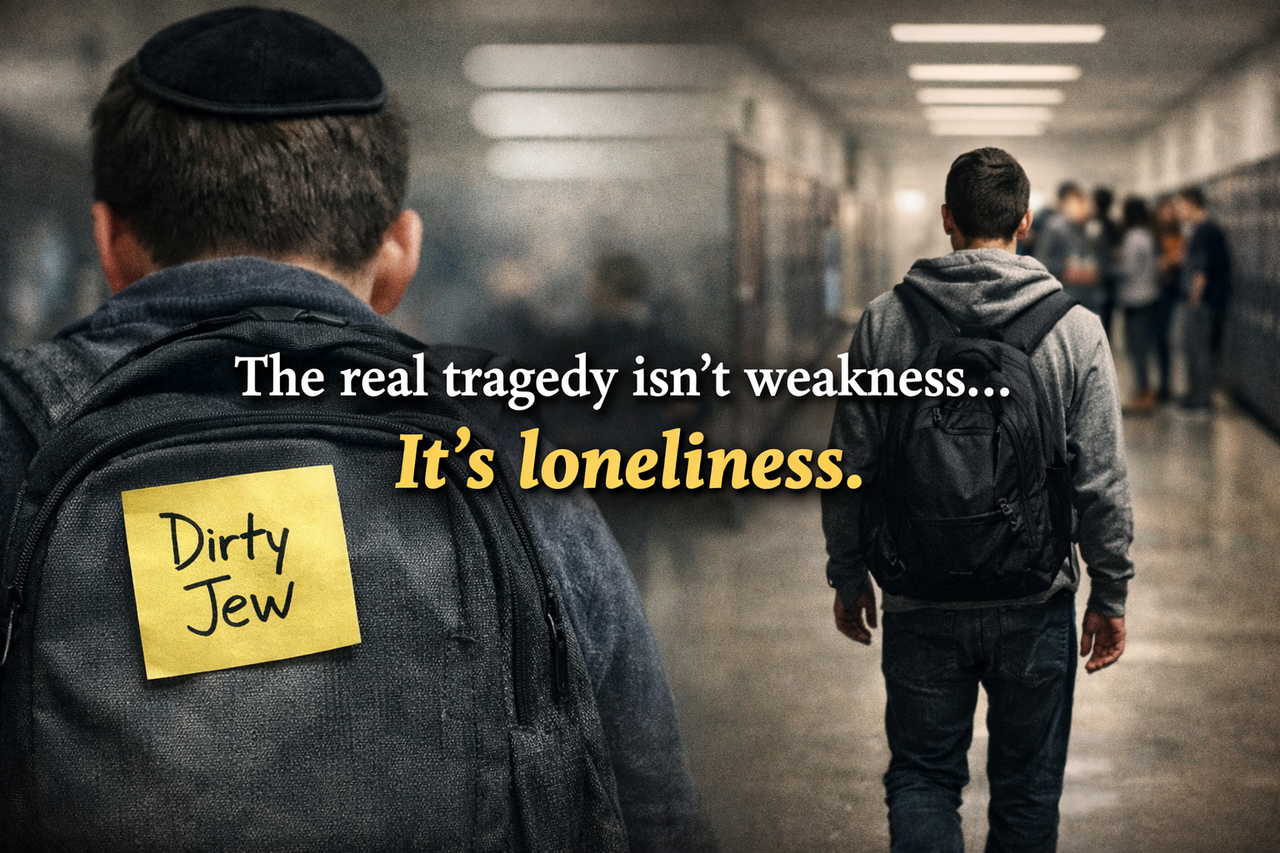
Overwhelmingly, everyone hated the Sticky Note ad.
A Jewish teen is walking through the halls of a classic American public high school when an antisemitic kid puts a sticky note on his bag reading, “Dirty Jew.” The rescue comes in the form of another teen who covers up the sticky note with a blue square, saying, “I know how it feels.”
Criticisms came from across the Jewish world. Some arguments were financial: Is this the best way to spend $15 million?! Others were frustrated by the blatant portrayal of Jewish weakness.
Many have noted that fighting antisemitism is a fundamentally broken notion—that instead of combating the world’s oldest hatred head-on, we should pour all of our resources into strengthening Jewish schools, shuls, and camps.
Some have added their voices to decry the implication that Jewish identity and Jew-hatred are somehow divorced from Israel.
In general, I agree with all of these critiques, and frankly, I’m not sure what, if anything, this ad has achieved.
I don’t know if any non-Jews have reconsidered their own responses to antisemitism as a result of seeing it. Ironically, it seems that the only audience still thinking about it is the Jewish community.
But there is one thing the ad gets right—and it’s a point that everyone seems to be missing...
Let’s consider the narrative as it’s portrayed. We should be asking: What options does this kid have? He is already ostracized and made into “the other.” If this were your child, what would you tell him to do?
Maybe you’d tell him to punch the guy in the teeth and escalate the fight? That would display Jewish strength, but the ramifications could end his academic career. Should he complain to the school authorities? Probably. But that’s not going to change anyone’s opinion of him.
Likely, in the vast majority of cases, the kid moves on without confronting his bullies. That’s how bullying usually works.
What the ad gets right is the sheer lack of practical and universal options for a Jewish teen in that situation.
To me, the darkest and most devastating part of the ad is not the lack of authority figures, or the lack of Israel. It’s not even the lack of any visible symbols of Jewish identity and observance.
The most devastating absence is the lack of other Jews.
Where are his Jewish friends? Why is he walking through the hallway by himself?
Robert Kraft’s ad is unwittingly calling out the Jewish community for allowing this situation to exist in the first place.
We are all at fault when a Jewish kid spends his high school career absent of Jewish friends and influence. The tragic reality is that these kids may grow to resent their Jewish identity.
R’ Simcha Bunim of Peshischa notes that our acceptance of the Torah is in the plural:
כֹּל אֲשֶׁר־דִּבֶּר ה’ נַעֲשֶׂה וְנִשְׁמָע
“All that Hashem has spoken, we will do and we will listen.”
Then he asks: How could it be that each and every Jew could say “we,” as if speaking for the entirety of Klal Yisrael?
Imagine a group of prisoners captured and chained in the sweltering summer heat. If a person came by and offered water, each one would answer, “We want water.” Sometimes, our collective need is so obvious that every Jew can speak for every other Jew.
The need for Torah, for Yiddishkeit, for Jewish community should be obvious.
If we’re content letting Jewish kids walk alone through public high schools, the best we can hope for is that someone else will extend a hand in friendship. If we don’t step up, we have relegated these kids to hoping for salvation in the form of a banal blue square from a random stranger.
The sad truth of the Sticky Note ad is that proud Judaism is unsustainable for a lonely individual.
Kids need community.
Klal Yisrael needs each other.